
My Julie Harris story.
When I was 9-3/4, my mother took me on her yearly weekend trip to Vermont to visit her old high school. We stayed at the Woodstock Inn for a night and visited the town, woods, and ski slopes where she'd perfected her "Christys," and drove by the turn-off to the Woodstock Country School as she extolled the delights of hiking and fresh air in her Brooklyn accent. Larry Hagman had also gone to that boarding school, a year or so ahead, but they weren't friends, especially since Mom wasn't a bit interested in dating boys.
On our way back from the pilgrimage to my mother's youth, we pulled into a restaurant in Connecticut to get a late lunch and help me recover from the car-sickness I felt from my mothers smoke filled-car and its rough rocking suspension.
"I'm sorry, we just closed."
"My girl really needs something to eat, could you please see if someone in the kitchen could help us with a bite?"
I was pale and swaying.
"All right," said the waitress returning from the chef, "but you can't sit in the dining room, we have a private party there, we can seat you in this side room."
As we followed her, Mom glanced through the dining room door as it swung shut and grabbed my arm and hoarsely whispered "Oh My God! Julie Harris. JULIE HARRIS!!! is sitting in there!"
Mom kept muttering Julie Harris to herself.
We sat down. I gulped my water and ate a breadstick. Mom stared at me. She tentatively tried to straighten my bangs (impossible), push the topiary of curls out of my face (hopeless), and reposition the cat-shaped tortoise shell eyeglasses that habitually slipped off-tilt down my nose.
"You're cute, all kids are cute," she began. I could see she was doing her best to believe this. The drool stains from when I'd managed to fall asleep sucking on a stick of licorice hardly showed on my shirt.
"Look, you're out of water, you walk in there with that empty glass and nicely ask the waitress for more water and then when Julie Harris looks at you tell her how much you loved her in The Member of the Wedding. She played a kid in that. Perfect. Go on." She wiped my mouth with a corner of her napkin. Squinted. Removed my glasses. Then wet her palms with water and squashed down my hair. "Go now. Better without the glasses, go on."
I was deeply myopic. I only bumped into a few chairs heading into the dining room peering about for the waitress… Julie and the man were absorbed in one of those tense weird adult conversations full of silences and conversational stabs. I tip-toed over. My heart hammered. Julie was skinny and not that much bigger than me.
"Could I please have some waaaa…." I began.
Julie and her companion startled and stared at me with the same expression one gives a newly produced hairball.
"I told you we wanted privacy, privacy, get out, get out!!" She shouted over my head.
The waitress ran in, a white aproned blur.
"Get out!"
I ran.
"We're never coming back here! Get me the check." was the last I heard.
I rejoined my mother, breathless and red-faced.
"How did it go, did you get her autograph?"
I shook my head.
"No…I don't think she likes kids."
"Mmmm, actresses, probably don't know what they're missing not having a girl like you."
I put my glasses back on and decided I'd earned French Toast with whipped cream for lunch.
"How could she not like you, you're so cute?"
"I dunno."
"Why didn't you get water?"
"Waitress wasn't there."
"That's where you went wrong! You should have waited to ask the waitress for water, you don't ask Julie Harris for water."
"I'll never do it again, Mom, promise."
Sunday, August 25, 2013

Saturday, August 10, 2013
Let the book get printed, embrace promotion!

My friend Flash suggested I could lead a workshop on how to take a regular lunch hour hangout and turn it into a project of seeing, of being there, using more of your senses, in the course of a year. That would be fun!
As I let this project stop, no more changes, revisions, additions, or deletions, I am still aware of the more perfect book I wanted it to be. This ghostly betterness has once again slipped my ability and I'm left with doingness. I created this book to the fullest, the most that I could and that feels right. I wish I had better mental and physical equipment (a small DSLR would be able to capture motion, which my pocket camera cannot) but hey, I can only be the me I am and as much as I'd like to borrow some O'Hara, Sylvia Plath or Donald Justice, Diane Arbus or Vivian Maier... I was stuck with me. No, revise that, I was me but I paid attention.
I will give readings and see if the Eventi Hotel wants to work with me on a way to celebrate the book. I can create a site. I'm agog.
My mind is turning to new books, in the perfect blur of possibility. Like falling in love. The work-in-progress is saying, Claudia, this time, this time you will get closer, and in the process surprise yourself. So here I come, goodbye done, hello beguiling.
Thursday, August 1, 2013
My first article on making fantasy maps is published!!!
I just received my copies of The Portolan, journal of the Washington map society. In 2011 I gave a talk in the map room of the library of congress to the society. The editor of the journal, Tom Sander, asked me to turn it into an article, with some of the images that had been in my PowerPoint slideshow. Since I'd sort of gone off script in the talk, my nervousness just miraculously evaporated as I spoke, I recreated the jist and added more to explain what I've learned over the years of making literary invented worlds become visible. I also looked at how changes in technology shaped how I worked. Not to mention fitting a universe in a tiny poorly printed paperback page. I got a bit more personal than the journal was expecting, but hopefully, their readers will enjoy hearing, again, about the joys, and sometime failures, of this particular craft.

- Posted using BlogPress from my iPad
- Posted using BlogPress from my iPad
Thursday, July 11, 2013
Final moments on cover and then I WILL MOVE ON
Creating the ad for Fall 2013 Marsh Hawk Press books...there are two
launching. Pocket Park has met its final count down. So will it be PATH, REFLECTION,
or TREES?


Sunday, June 30, 2013
Cover me round 2, more abstract mostly
I thank everyone who voted on the covers I put together yesterday, your comments and reactions got me thinking about getting more mysterious, abstract, and focused. So here are today's contestants (click to see larger):
 |
| A, front runner from yesterday |
 |
| B |
 |
| C |
 |
| D |
 |
| E |
 |
| F |
 |
| G |
Saturday, June 29, 2013
Cover me!
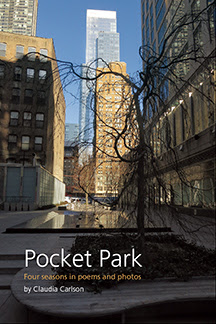
I'm finishing my book Pocket Park and getting files ready to go to the printer. The inside is done, the library of congress data arrived and I put it in its slot on the copyright page, I've made final corrections, and it will soon fly out of here on it's electrons.
But now—the cover. Do I have the best photo for it?
The one I picked is rather dark, suggesting the poems are likewise, and mostly, they aren't. But I'm afraid of using something too bland, too meh. So tell me, which ones look best?
Note, A is the current cover.
Summer Haiku
Trees discuss the heat,
lack of soil, they sigh and creak
in their rough girdles.
The US Open in the Pocket
The ball pocks
from serve to racket
heads swivel
following the play
on the outdoor
mega-wall display
pock—pock—pock
the pixelated ball
is the irregular beat
of a collective heart
sparrows hop
close and closer
to unguarded bounty
as Forest Hills
thrills New York county.
But now—the cover. Do I have the best photo for it?
The one I picked is rather dark, suggesting the poems are likewise, and mostly, they aren't. But I'm afraid of using something too bland, too meh. So tell me, which ones look best?
Note, A is the current cover.
 |
| A |
 |
| B |
 |
| C |
 |
| D |
 |
| E |
 |
| F |
 |
| G |
 |
| H |
 |
| I |
 |
| J |
 |
| K |
Summer Haiku
Trees discuss the heat,
lack of soil, they sigh and creak
in their rough girdles.
The US Open in the Pocket
The ball pocks
from serve to racket
heads swivel
following the play
on the outdoor
mega-wall display
pock—pock—pock
the pixelated ball
is the irregular beat
of a collective heart
sparrows hop
close and closer
to unguarded bounty
as Forest Hills
thrills New York county.
Friday, June 28, 2013
Da Dawg Days in June

Sculpture in plastic clay of a character for a kids book I'm writing. Oh this is fun.
I used to sculpt a lot in high school. But when I got to college the studio art department was in the grips of worshiping abstract and conceptual art. Especially in artist's statements.
"Carlson, paint what you feel!"
Me, "I'm a freshman, I don't know what I feel. Can't I paint what I see?"
They thought they could quickly turn us 18-year-olds into Pollocks just by skipping the whole old fashioned training in anatomy, perspective, and color theory. Talent trumped technique.
They didn't much like realism. They sneered at illustration. The word "cute"was the worst insult. Sigh. So I became an English/Art History major. And turns out life is funny that way, discovered how much I liked writing and reading poetry. And kept reading children's books and cartoons.
Friday, May 31, 2013
Rewriting against the clock
My second book of poetry (Pocket Park) will be coming out this Fall, but thanks to sequesters and unknowable seethings in the Library of Congress, my library data is held up. This offers the self doubting poet an excuse to revisit the entire book looking for awkward verbs, sad near rhymes, and potentially horrifying verbal gaffes on a par with my recent sartorial mishaps (the navy blue and black sock debacle on Tuesday). And in my deepest soul I wish I had written the deeper, funnier, more astonishing and intelligent book I envisioned at the start. But this is the truth of it, like watercolor, once the paint of a poem dries, it looses some gloss and movement. Unless you're effing brilliant like Plath but god knows I don't want her self-imposed deadline.
 I've been reading many poets on revision. Such great advice. Decided to follow all of it. I've got one poem I'm putting through the paces right now. Made it shorter, expanded it, rhyme, no rhyme, amoeba like, tailored to form, mixed it up...and the poem remained of faint interest, no zing. It needs more of me somehow. Great, how do I extract heart, experience, and vision and make it new?
I'm sipping a small glass of sherry...Amontillado...and pondering options. Going to sleep sounds good. Getting out from behind the wall of myself sounds better. Hand me some TNT and courage please. Or maybe I need to stop being so pleasing. You must kill the obvious darlings, the poet as her own editor must be fierce.
Mmmmm, a vintage port would be nice. No poetry readjustment bureau tonight. Tomorrow is Jim's birthday, we plan to go write in a cafe and nibble appetizers. Poem, gird yourself. Deadlines.
- Posted using BlogPress from my iPad
I'm sipping a small glass of sherry...Amontillado...and pondering options. Going to sleep sounds good. Getting out from behind the wall of myself sounds better. Hand me some TNT and courage please. Or maybe I need to stop being so pleasing. You must kill the obvious darlings, the poet as her own editor must be fierce.
Mmmmm, a vintage port would be nice. No poetry readjustment bureau tonight. Tomorrow is Jim's birthday, we plan to go write in a cafe and nibble appetizers. Poem, gird yourself. Deadlines.
- Posted using BlogPress from my iPad
Location:Couch
Sunday, January 13, 2013
Less is Less Unless it is More Good News
THE LESS AND LESS PART
Last week I visited the Utrecht Art store, near where I work, and discovered their big redesign of all their retail outlets meant they dumbed down their offerings. Gone was the large cutting table where I could layout boards and decide how to frame my art. Gone were the useful array of books on art and technique (now down to one woefully inadequate kiosk with a dozen fairly useless titles and not even one book on calligraphy) and the general air of being a place that mattered was gone. I had remembered an energetic knowledgeable staff, dynamic manager, shelves with many good choices of tools, papers, and paints...and discount tables. It is now a sort of E-Z artsy store, akin to the art section in the Micheal's Craft stores. The place was like the cat that had gone to be "fixed" and came back with depleted interests... clearly the digital world is affecting viability of art stores. Will they mostly go the way of bookstores leaving behind just a few small specialty shops catering to real artists?
Lately I've had a "Potemkin Shelf" feeling at the big Barnes and Noble (Broadway and 82nd Street). As if the books being turned face out were the last in line. There's a subtle thinning of the stock...just what Borders went through in its final months. It makes me sad. Bookstores have been a mecca for my cover design eye and a feast for my insatiable reading heart. And big mega stores just means more walking and looking and browsing—a place where I pleasantly split into two selves in one, my body relaxes into a slowly strolling trance and my mind and eye are darting and diving—reuniting at the end of the checkout line. Luckily I still live in a college neighborhood where print books will last as long as there are students and professors to read or assign them. Also, I thank the graces for the New York Public Library....
THE GOOD NEWS PART
Yesterday I ran over to Book Culture and bought a used paperback copy of William Carlos Williams book long poem Patterson. I am writing a book of poems about a small urban park—sharing space with my photos. I'm looking for inspiration, other ways of seeing. This tip came from Paul Pines, "one of the best collections of cityscape poetry is by my old friend and mentor Paul Blackburn in a book called The Cities, published by Evergreen. I recommend it highly. And in all of his work Paul had an eye for detail and ear for sounds and speech that was peerless and informs his work. He was a protege of Williams, whose classic book Patterson is another great one (both alluding to Lorca in some way, his Poet in New York). That book by Paul contains his great good-bye to W.C., "Phone Call to Rutherford," that great moment when Williams, unable to speak because of his heart attack, says, "...you have made a record on my heart."" I had looked at passages from Patterson back in college but what a different rich cornucopia it is to me now! Thank you for the leads.
So this brings me to my news, my book, Pocket Park, will be coming out Fall of 2013 from Marsh Hawk Press!!!!!!! I have 4 months to take the rough manuscript and finish, rewrite, reimagine, and find where I can add or subtract. What are the best city park poems you have read? Let me know, I'm stoking my imagination for the work and play ahead.
Last week I visited the Utrecht Art store, near where I work, and discovered their big redesign of all their retail outlets meant they dumbed down their offerings. Gone was the large cutting table where I could layout boards and decide how to frame my art. Gone were the useful array of books on art and technique (now down to one woefully inadequate kiosk with a dozen fairly useless titles and not even one book on calligraphy) and the general air of being a place that mattered was gone. I had remembered an energetic knowledgeable staff, dynamic manager, shelves with many good choices of tools, papers, and paints...and discount tables. It is now a sort of E-Z artsy store, akin to the art section in the Micheal's Craft stores. The place was like the cat that had gone to be "fixed" and came back with depleted interests... clearly the digital world is affecting viability of art stores. Will they mostly go the way of bookstores leaving behind just a few small specialty shops catering to real artists?
Lately I've had a "Potemkin Shelf" feeling at the big Barnes and Noble (Broadway and 82nd Street). As if the books being turned face out were the last in line. There's a subtle thinning of the stock...just what Borders went through in its final months. It makes me sad. Bookstores have been a mecca for my cover design eye and a feast for my insatiable reading heart. And big mega stores just means more walking and looking and browsing—a place where I pleasantly split into two selves in one, my body relaxes into a slowly strolling trance and my mind and eye are darting and diving—reuniting at the end of the checkout line. Luckily I still live in a college neighborhood where print books will last as long as there are students and professors to read or assign them. Also, I thank the graces for the New York Public Library....
THE GOOD NEWS PART
Yesterday I ran over to Book Culture and bought a used paperback copy of William Carlos Williams book long poem Patterson. I am writing a book of poems about a small urban park—sharing space with my photos. I'm looking for inspiration, other ways of seeing. This tip came from Paul Pines, "one of the best collections of cityscape poetry is by my old friend and mentor Paul Blackburn in a book called The Cities, published by Evergreen. I recommend it highly. And in all of his work Paul had an eye for detail and ear for sounds and speech that was peerless and informs his work. He was a protege of Williams, whose classic book Patterson is another great one (both alluding to Lorca in some way, his Poet in New York). That book by Paul contains his great good-bye to W.C., "Phone Call to Rutherford," that great moment when Williams, unable to speak because of his heart attack, says, "...you have made a record on my heart."" I had looked at passages from Patterson back in college but what a different rich cornucopia it is to me now! Thank you for the leads.
So this brings me to my news, my book, Pocket Park, will be coming out Fall of 2013 from Marsh Hawk Press!!!!!!! I have 4 months to take the rough manuscript and finish, rewrite, reimagine, and find where I can add or subtract. What are the best city park poems you have read? Let me know, I'm stoking my imagination for the work and play ahead.
Monday, October 29, 2012
Claudia Carlson, age 18, journal entry May 24, 1975, Brooklyn, NY
This old flesh and it’s hers. I
see how wasted she is. He hair was once so black you could see blue (of
reflected sky?) in it. It is gray now and wispy-sad. Her stomach protrudes like
a pregnant woman’s. An odd melon, the frost of the vine is so thin its sap
retreating. A vine just waiting for the last frost, or is it the first? The
frost that all the farmers wait for, the frost that signals winter killing the
crops. Snow. We used to play in the snow. She was ever so young then, her teeth
and eyes were always wet and so white. And she was tall then with that
marvelous beauty mothers always have. She throws snow at me, I laugh dodging
the crisp wet. Giggling we fall down. All the snow the world, mother it is ours
then, a moment of being. No other words can express it, our day.
Walking, we are walking to the
car? Our little blue English Ford Anglia. I know it is cold out and night for
as we cross the street I feel that brown of the night. But where we are it is
light. I think that light must emanate from the bag of warm peanuts we carry.
They were so good those peanuts. I have never again tasted any so good as
those. Night, holding your hand as we walk to the car after the show. The bag
of warm peanuts.
Today you threw-up when you ate a
pretzel.
When you eat and work you carry
that bewilderment Grandaddy had before he died, when he was so so old.
He would slowly wheeze over to
his chair of 50 years and arthritically drop himself into it. He would be so
lost then. Then he would start to read his New
Yorker but always his eyes shut and his head lolled to the side. His mouth
open (pitiful yellowed teeth) and a small bit of drool would slowly make its
way to his shirt. He would sleep.
Fumbling awake, his eyes lost in
the past, he never could understand what this world now was doing. As time went
on he understood less and less. He began to look like an aged baboon. (He
always called me his “little monkey”) After awhile those bones ceased to live.
My grandfather died and there was no love for him in my heart.
Today I saw how slowly she sat
down. I saw that her body was as old as my grandfathers. She seemed so lost but
I knew there was a difference. She is alive now because her past holds no
hopeful maybes.
Oh lord, how sentimental, it
makes me sick. The nauseous outpouring. It is purge. No art in this pathetic
pity.
I do not cry for you, I cry for
myself watching you.
Soon, if you cannot eat they will
send you to the hospital. You will not leave there until you die.
When you ate your potatoes and
sour cream tonight you hardly seemed aware of the mess of food in and around
your mouth. I was embarrassed. Sin of disdain. I was embarrassed. I hate myself
for that.
When you inquired of me and my
visiting friend Lisa [Lisa Berger] if you looked horrible, I was a traitor. I
gave you the perfunctory answer, “No, no mother, you look fine.” Traitor. I
should carry a sign pronouncing me guilty of nontruth in the face of cancer.
People die ugly. I am not
expected to love the physical that is, I must love that which was. How lucky I
am that her mind is still hers. Or unlucky. She remembers her distrust and lack
of faith in me. I have earned such disappointment.
Why couldn’t I do what I should
have? Why wasn’t I even part of what you wanted me to be? I am your Judas. Your
daughter who does not keep the irritation out of her voice.
I hate you for being sick. How
dare you be dying. Why were you so damn self-destructive? I will die believing
that your 30 years of smoking were your suicide.
You are just as selfish as I am.
But I am young—you have every excuse. I have no right to ask you to die like a
saint. You die as you lived, intensely. Your life seeped with bitterness and a
strange child-like hope. How can I ever explain all your complexities and
simplicity to another person? The brilliancy and faith in the impossible. How
could a mind like yours believe in astrology? Or is it that only your mind
could justify such a thing?
Poor Lisa. I invited her here not
knowing how sick mom had gotten. I think I shall have to send her home again. I
don’t want to make her live through your death agonies. It is not right.
Perhaps you will just keep
fading. I am glad Dad is coming tomorrow.
Tomorrow, later.
-----
I had a journal I lost in the
fire, that was much more detailed about my life at 18 and the final year of my
mother’s life. I though I’d lost all the writing from that year. Then today, in
one other journal I didn’t know I had, I found the entry above.
My mother went to the hospital a
day later and died. My friend Lisa stayed with me the whole time as I waited at
home, spared that trip and guilty I didn’t go. My grandmother and “Aunt”
Shirley told me my mother essentially drowned, slipped into a coma, and only in
death looked calm. My father and stepmother came and took me to Long Island.
Neighbors broke in and stole anything of value including my mother’s lovely
silver Mexican jewelry. There were three more funerals that spring. Around the
time my mother died, my father’s brother had a heart attack in his sleep and
Dad with the police found him in bed three days later. Awful time.
The only thing I changed was the
spelling, I let spell check fix my mistakes.
Sunday, September 23, 2012
Ability to catch a likeness & inherent facial recognition
I read an article in New Scientist about super-recognizers. People with a freakish ability to recognize faces. Useful in law enforcement, such as matching blurry survalence screencaptures to mug shots or recognizing persons of interest despite their wearing a Mets cap and purple lipstick.
While I am not a super-recognizers, I suspect I am closer to the top of that bell curve. When my husband and I attend events or watch TV I'm constantly recognizing people and he can't. But he frequently recognizes voices while I rarely can.
I've been drawing portraits a long time. I love looking at faces. People, including other artists, will say it must have taken me years of practice to be able to capture a likeness. I nod in agreement, not wanting to hurt their feelings, but it just isn't so. Yes, it has taken time to get comfortable with the materials, such as watercolor, ink, pastels, and now digital. What I don't tell them is this, I was able to do it the first time I tried.
When I was nine years old my mother, at one time a dabbler in art, sat me down and put a pad of good charcoal paper in my lap and handed me a stick of charcoal. Up to this point I'd only drawn the usual princesses and horses with crayons in a style that would be universally recognized as uninfluenced by observation of reality.
"Draw me" she said.
I remember that first portrait so clearly, gauging the widths and planes, the way some parts of her face seem to repeat themselves in style—a signature pointiness in ears and nose wings...what I now think of as fractals of facial development. I am back in our den, in our fine small house in West Hartford, the scratch and slur of my lines echoing my mother's face.
20 minutes later she demanded to see what I'd done.
She looked startled and then pleased. It looked like her. After that, I got extra art lessons.
I don't know if this ability is a genetic gift or oddity of development, but my father, Elof Carlson, as a young man, before he pursued a career as a geneticist, was able to draw portraits that also captured a likeness.
Unlike the super recognizers I do forget faces and almost always names. I'll walk by someone and get a flash of recognition...if you see me on the street and I'm staring at you while alternately looking off to my left it isn't sleepwalking or lack of meds, I know I know you and cannot approach because your name is a blank. However, your nose or chin will stay with me, until next time then.
While I am not a super-recognizers, I suspect I am closer to the top of that bell curve. When my husband and I attend events or watch TV I'm constantly recognizing people and he can't. But he frequently recognizes voices while I rarely can.
I've been drawing portraits a long time. I love looking at faces. People, including other artists, will say it must have taken me years of practice to be able to capture a likeness. I nod in agreement, not wanting to hurt their feelings, but it just isn't so. Yes, it has taken time to get comfortable with the materials, such as watercolor, ink, pastels, and now digital. What I don't tell them is this, I was able to do it the first time I tried.
When I was nine years old my mother, at one time a dabbler in art, sat me down and put a pad of good charcoal paper in my lap and handed me a stick of charcoal. Up to this point I'd only drawn the usual princesses and horses with crayons in a style that would be universally recognized as uninfluenced by observation of reality.
"Draw me" she said.
I remember that first portrait so clearly, gauging the widths and planes, the way some parts of her face seem to repeat themselves in style—a signature pointiness in ears and nose wings...what I now think of as fractals of facial development. I am back in our den, in our fine small house in West Hartford, the scratch and slur of my lines echoing my mother's face.
20 minutes later she demanded to see what I'd done.
She looked startled and then pleased. It looked like her. After that, I got extra art lessons.
I don't know if this ability is a genetic gift or oddity of development, but my father, Elof Carlson, as a young man, before he pursued a career as a geneticist, was able to draw portraits that also captured a likeness.
Unlike the super recognizers I do forget faces and almost always names. I'll walk by someone and get a flash of recognition...if you see me on the street and I'm staring at you while alternately looking off to my left it isn't sleepwalking or lack of meds, I know I know you and cannot approach because your name is a blank. However, your nose or chin will stay with me, until next time then.
Sunday, September 2, 2012
Reading, poetry self-help column and diversions
Since I've been working too much and creating too little lately, I wanted to inspire myself now that the BIG freelance job is over (sounds of cheering).
I bought a paperback of Ted Kooser's The Poetry Home Repair Manual. So far, I like it. He explains clearly, based on a lifetime of writing and teaching. For instance Kooser says he may revise a poem up to 40 times "to revise toward clarity and freshness, and I hope that after I have labored over my poems for many hours they look as if they'd been dashed off in a few minutes, the way good watercolor paintings look." More to add when I finish the book.
I took out Mary Oliver's Rules for the Dance from the library. She covers prosody just perfectly and has a short but lovely collection of older classic poems to illustrate her points.
----------
And just in case you think I've stopped reading my usual YA fantasy books, here are 3 quick reviews:
The False Prince by Jennifer A. Nielsen: first in a trilogy, a group of orphan boys are secretly trained to impersonate the lost prince. I found it totally engaging, the narrator Sage is clever and mischievous, and faced with awful choices if he wishes to survive, for only one boy can claim the throne. Engrossing, went on a bit too long in spots. The climax no surprise. I'd give this one an A-
Keeping the Castle by Patrice Kindl. Kindle has kept this fan waiting 10 years for her next book and this is a Jane Austen homage using a Pride and Prejudice meets Emma as an armature. It is funny, lively, and not very true to the historic period, but hey, it is a fine diversion. I loved the first person narrator Althea who must force herself to marry a wealthy man in order to literally keep the roof over her head. She is in fine form when it comes to manipulating her stingy and heartless step-sisters who jealously hold the purse-strings since they inherited all the wealth. At times the 21st century poked through too much, but it was amusing all the way. I laughed out loud. B+
Cinder by Marissa Meyer. Cyborg Cinderella in a dystopia that faces plague and possible invasion from the nasty folks on the moon. I know it sounds nuts—in a Flash Gordon way—but this is a delightful revamping of the familiar fairy tale. The partially human heroine is a mechanic and must obey the whims of her stepmother in a society that disenfranchises cyborgs (and augmented humans). At times the plot seemed to take too long and some of the secondary characters are under developed. We feel for our plucky self-abasing Cinder. More books to follow and I am hopeful this author will improve, this was fun, original, and I look forward to the next installment. B+
I bought a paperback of Ted Kooser's The Poetry Home Repair Manual. So far, I like it. He explains clearly, based on a lifetime of writing and teaching. For instance Kooser says he may revise a poem up to 40 times "to revise toward clarity and freshness, and I hope that after I have labored over my poems for many hours they look as if they'd been dashed off in a few minutes, the way good watercolor paintings look." More to add when I finish the book.
I took out Mary Oliver's Rules for the Dance from the library. She covers prosody just perfectly and has a short but lovely collection of older classic poems to illustrate her points.
----------
And just in case you think I've stopped reading my usual YA fantasy books, here are 3 quick reviews:
The False Prince by Jennifer A. Nielsen: first in a trilogy, a group of orphan boys are secretly trained to impersonate the lost prince. I found it totally engaging, the narrator Sage is clever and mischievous, and faced with awful choices if he wishes to survive, for only one boy can claim the throne. Engrossing, went on a bit too long in spots. The climax no surprise. I'd give this one an A-
Keeping the Castle by Patrice Kindl. Kindle has kept this fan waiting 10 years for her next book and this is a Jane Austen homage using a Pride and Prejudice meets Emma as an armature. It is funny, lively, and not very true to the historic period, but hey, it is a fine diversion. I loved the first person narrator Althea who must force herself to marry a wealthy man in order to literally keep the roof over her head. She is in fine form when it comes to manipulating her stingy and heartless step-sisters who jealously hold the purse-strings since they inherited all the wealth. At times the 21st century poked through too much, but it was amusing all the way. I laughed out loud. B+
Cinder by Marissa Meyer. Cyborg Cinderella in a dystopia that faces plague and possible invasion from the nasty folks on the moon. I know it sounds nuts—in a Flash Gordon way—but this is a delightful revamping of the familiar fairy tale. The partially human heroine is a mechanic and must obey the whims of her stepmother in a society that disenfranchises cyborgs (and augmented humans). At times the plot seemed to take too long and some of the secondary characters are under developed. We feel for our plucky self-abasing Cinder. More books to follow and I am hopeful this author will improve, this was fun, original, and I look forward to the next installment. B+
Paintshop Pro, from iPad to iMac
I saw great reviews for the new Sketchbook Pro (version 6) drawing program for the computer. Introductory price of $29. Since I've been using the pared down version on my iPad, I knew I liked it. So, yes, I got the full version for a full computer. Sketchbook Pro is so much cheaper than the industry leader
Corel Painter 12. I know Sketchbook has fewer features, but hey, at
1/15th the price... deal! I can bring the files into Photoshop for the things it can't do.
There is more you can do of course on a program designed for a full operating system and plenty of memory, and I also used my Wacom tablet and took advantage of pressure sensitivity. Two hours later I had done a self-portrait, graphic novel style, a tough as nails version of me (yes, a bit younger looking), influenced by watching the movie The Hunger Games the night before. The middle aged Catniss Carlson? Except for a bow and arrow, I'd have to cut contestants down with my number 11 blade X-Acto knife.
Jim suggested a great article at Lifehacker about practice, the kind that only helps a little (mindless or overly repetitive; such as how I did piano lessons: start at beginning, make a mistake, stop, start over and repeat--so only able to play beginning well!) and mindful (working out problems and trying multiple solutions). With this study, I thought about how to balance line with color so that it didn't get too finished, I wanted to keep a sketchy loose feel. I have plans to illustrate a picture book and want to develop the level of skills to do it. I was also dealing with a light source that had no strong direction and wanted to see how much of the purple shirt I should reflect back into the face.
What should I do next? I am frightfully bad at doing whole scenes, if I take it piece by piece, try this, try that, I may finally get the level of abstraction I need to do a landscape with a narrative event, i.e., an illustration.
There is more you can do of course on a program designed for a full operating system and plenty of memory, and I also used my Wacom tablet and took advantage of pressure sensitivity. Two hours later I had done a self-portrait, graphic novel style, a tough as nails version of me (yes, a bit younger looking), influenced by watching the movie The Hunger Games the night before. The middle aged Catniss Carlson? Except for a bow and arrow, I'd have to cut contestants down with my number 11 blade X-Acto knife.
Jim suggested a great article at Lifehacker about practice, the kind that only helps a little (mindless or overly repetitive; such as how I did piano lessons: start at beginning, make a mistake, stop, start over and repeat--so only able to play beginning well!) and mindful (working out problems and trying multiple solutions). With this study, I thought about how to balance line with color so that it didn't get too finished, I wanted to keep a sketchy loose feel. I have plans to illustrate a picture book and want to develop the level of skills to do it. I was also dealing with a light source that had no strong direction and wanted to see how much of the purple shirt I should reflect back into the face.
What should I do next? I am frightfully bad at doing whole scenes, if I take it piece by piece, try this, try that, I may finally get the level of abstraction I need to do a landscape with a narrative event, i.e., an illustration.
 |
| Self portrait Sept 3, 2012, 1st Sketchbook pro attempt. |
Subscribe to:
Posts (Atom)


 Posts
Posts

